If you've ever asked whether allergies are worse in New York or Los Angeles, the honest answer is "it depends on the month—and the question itself misses what makes each city hard." New York and Los Angeles produce dramatically different pollen years. New York's allergy calendar is a sharp spring-and-fall barbell with a quiet winter, while Los Angeles smears pollen across nearly every month at lower amplitude. This guide walks through the comparison season by season, names the species that drive each peak, and shows what the year looks like in a single chart.
Two Climates, Two Different Pollen Years
Climate, not just plant species, dictates how pollen moves through the year. New York sits at the boundary of a humid subtropical (Köppen Cfa) and humid continental (Dfa) climate. Hard winter freezes shut down photosynthesis, force trees into dormancy, and wipe pollen counts to near-zero from December through February. When temperatures rise in March, everything starts at once.
Los Angeles is Mediterranean (Köppen Csa/Csb), shading toward semi-arid in inland valleys. Winters are mild and wet, summers are dry and hot, and the freeze line that forces eastern trees into dormancy never arrives. Some species pollinate as early as December, ornamental imports keep the air loaded year-round, and the absence of a hard winter reset means there is no clean off-season. Those climate differences explain almost everything else in this comparison.
Spring: Tree Pollen Is the Headline in Both Cities, but They Don't Peak at the Same Time
In New York, tree pollen builds from mid-March through early May. The dominant allergens are oak (Quercus spp.), birch (Betula), maple (Acer), sycamore (Platanus occidentalis), hickory (Carya), ash (Fraxinus), and mulberry (Morus). Oak alone can release pollen for six to eight weeks, and birch produces one of the most potent tree allergens—the protein Bet v 1—that triggers symptoms even at low airborne concentrations. By late April most of these species are pollinating simultaneously, which is why allergy clinics in the Northeast see their highest patient volume in that window. If you want to understand how to interpret the daily numbers during this period, see our guide to reading a pollen forecast.
In Los Angeles, tree pollen season starts earlier and runs longer. Juniper and cypress can begin pollinating in December. By January, the city's planted olive trees (Olea europaea) start to release pollen, peaking March through May. Pepper tree (Schinus molle), mulberry, ash, sycamore (Platanus racemosa), coast live oak (Quercus agrifolia), and walnut (Juglans) follow through spring. Olive's role in LA is so prominent that several Southwestern cities have banned the planting of new olive and mulberry trees as a public-health measure—Albuquerque in 1994, Tucson and El Paso similarly—though Los Angeles itself never did, leaving a large legacy population of mature trees that still pollinate every year.
The distinction matters: New York's tree spring is shorter and more intense, but compressed into eight weeks. LA's is broader and starts a month or two earlier, with a different cast of allergens. Someone with a confirmed birch allergy will suffer more in New York. Someone with an olive or pepper tree sensitivity will suffer more in Los Angeles. For the underlying mechanisms behind tree pollen reactions and which species cross-react, see our tree pollen allergies guide.
Summer: Grass Pollen—Similar Peaks, Different Shapes
Grass season in New York runs from late May through July. The main contributors are Kentucky bluegrass (Poa pratensis), tall fescue, perennial ryegrass, and timothy (Phleum pratense)—all cool-season grasses common in irrigated lawns and roadside strips throughout the metropolitan region. Counts climb sharply in late May, peak in mid-June, and taper into July as heat stresses the grasses.
Los Angeles grass season starts earlier (April) and runs longer (into August or September), but rarely reaches the same daily peak intensity. The dominant species there is Bermuda grass (Cynodon dactylon), a warm-season grass adapted to dry summers, joined by perennial ryegrass in irrigated lawns and Bahia in greener inland areas. Because Bermuda is wind-pollinated and pollinates over a longer window, LA grass exposure is more about cumulative dose than peak day. New York's grass season hits harder for a shorter period—LA's is gentler but lasts twice as long.
For most allergy sufferers the experience is roughly comparable in summer—both cities show up in NAB-tracked top-25 grass-pollen lists in different years.
Fall: Ragweed Is Where New York Pulls Ahead
If you have a ragweed allergy, New York is meaningfully worse than Los Angeles. Common ragweed (Ambrosia artemisiifolia) and giant ragweed (A. trifida) thrive in disturbed soils, lot edges, and farmland throughout the Northeast and Mid-Atlantic. Ragweed pollen begins releasing in mid-August, peaks in September, and continues until the first hard frost—typically late October or early November in NYC. A single ragweed plant produces up to 1 billion pollen grains, and the grains are small enough (about 20 microns) to penetrate deep into nasal and bronchial passages.
Ragweed is much less abundant in Los Angeles. The species exists, but it requires summer rainfall to establish, and LA's bone-dry summers suppress it. What replaces ragweed in the LA fall calendar is a different cast: mugwort (Artemisia spp.), Russian thistle (Salsola tragus, the airborne tumbleweed), pigweed (Amaranthus), English plantain, and sagebrush from inland and desert margins blowing into the basin during Santa Ana wind events. These cause real symptoms, but at lower aggregate intensity and without the population-level prevalence ragweed has nationally.
The practical takeaway: a ragweed-allergic New Yorker who travels to LA in September will likely feel dramatic relief. An LA resident with mugwort or Russian thistle allergies who visits NYC in fall may feel fine—the triggers aren't there.
Winter: Where Los Angeles Is Unusual
December and January in New York are the cleanest pollen months of the year. Trees are dormant. Grasses are senesced. Weeds are dead. Counts hover near zero. That clean off-season is the trade-off for the sharper spring and fall.
Los Angeles has no equivalent off-season. Cypress and juniper begin pollinating in December and accelerate through January. Acacia (Acacia spp.)—common as an ornamental and along roadsides—releases pollen January and February. Olive trees, depending on the variety and microclimate, can start as early as late January in coastal areas. The result is a measurable winter pollen baseline that simply doesn't exist in New York.
The non-zero baseline catches Northeastern transplants off guard. People often expect "no winter pollen" to mean "no pollen in winter" and are surprised by symptoms in January. It's not that LA winter pollen is high in absolute terms—it's that the floor isn't zero.
The Full Year in One Chart
The seasonal comparison is easier to see than to read. Here's the typical year for both cities, plotted as a monthly pollen index:
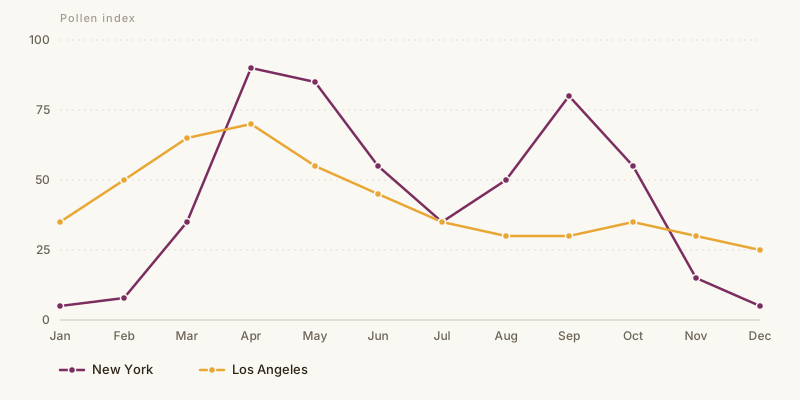
Chart informed by historical monthly counts published by the AAAAI National Allergy Bureau (pollen.aaaai.org/nab) and regional NOAA climate normals (1991–2020). Values are typical-year illustrative averages—daily counts vary substantially with weather and year-to-year plant phenology.
The shape difference is the takeaway. New York has two distinct mountains separated by a valley. Los Angeles has one long, irregular plateau that never quite drops to baseline. Two cities, one chart, two different management strategies.
What This Means if You're Traveling, Moving, or Visiting
A few practical implications fall out of the seasonal comparison:
- NYC → LA in September—ragweed-driven fall allergy sufferers usually feel substantial relief. The trigger isn't there.
- NYC → LA in February—Northeasterners arriving in winter may suddenly experience symptoms they associate only with spring back home. Olive and juniper are likely culprits.
- LA → NYC in May—anyone sensitive to oak, birch, or maple will likely have a worse-than-usual spring, especially if they've never been east during peak tree pollen.
- LA → NYC in September—ragweed exposure may produce symptoms that LA never triggered. Of all the moves, this season surprises transplants the most.
- Year-round LA residents with grass or weed allergies: a daily forecast is more useful than a seasonal calendar, because the seasons blur.
- Year-round NYC residents: a seasonal calendar is enough for planning, but daily checks during the April–May and September windows pay off.
Where the Cities Are Surprisingly Similar
A few patterns hold in both places. First, both are urban heat islands, and urban warmth has been extending pollen seasons across North America. A 2021 study in Proceedings of the National Academy of Sciences (Anderegg et al.) found that pollen seasons in North America have lengthened by roughly 20 days over three decades, with airborne pollen concentrations up about 21 percent. Both cities are squarely in the trend line—for an explainer on how seasons have shifted and why, see our guide to understanding pollen seasons.
Second, both cities show a clear correlation between rainfall the prior winter and pollen intensity the following spring. Wet winters mean more biomass, which means more pollen.
Third, both metros are large enough that sub-regions experience different pollen profiles. The San Fernando Valley is hotter and drier than coastal Santa Monica, with different species mixes—valley olive and juniper exposure runs higher than along the coast, where ocean air dilutes counts. Brooklyn is milder than the Hudson Valley suburbs, where tree canopy is denser and oak counts run higher. Citywide averages hide variation that matters at the neighborhood level, which is why the same official forecast can feel accurate to one resident and wrong to another a few miles away.
Finally, both cities sit in dense corridors where pollen transport from outside the metro area can dominate local sources during certain weather patterns. Northeast cold fronts can pull ragweed pollen into NYC from upstate and New Jersey farmland in late summer. Santa Ana wind events push desert and inland-valley pollen into the LA basin from the east. On those days, the local plant inventory tells you almost nothing about what's in the air.
Check Today's Count
The seasonal picture earlier in this guide is the backdrop. What you need on any given morning is the daily forecast for your city. Pull up today's New York forecast or today's Los Angeles forecast—both are updated every morning with tree, grass, and weed breakdowns.
If you're trying to interpret the daily score in light of the seasonal pattern this article walked through, the pollen forecast guide explains what the index ranges mean for symptoms.
Sources and Further Reading
- AAAAI National Allergy Bureau (NAB), monthly station data—
https://pollen.aaaai.org/nab - Anderegg, W.R.L. et al. (2021). "Anthropogenic climate change is worsening North American pollen seasons." Proceedings of the National Academy of Sciences 118 (7).
- NOAA U.S. Climate Normals 1991–2020—
https://www.ncei.noaa.gov/products/land-based-station/us-climate-normals - USDA Plant Hardiness Zone Map—
https://planthardiness.ars.usda.gov - Ogren, T. (2015). The Allergy-Fighting Garden (OPALS allergenicity index).