If you've read our NY vs. LA pollen guide, you already know how dramatically pollen seasons can diverge between cities in different climates. New York vs. Chicago is the opposite case. These two cities sit in the same climate family—both humid continental, both with hard winters and clear seasonal peaks—and at first glance their pollen calendars look almost identical. But the differences are real, structured, and worth understanding if you live, travel, or move between them. Chicago's spring runs roughly two weeks behind New York's, its ragweed load is meaningfully heavier, and Lake Michigan introduces a daily local effect on counts that New York doesn't have.
Two Cities, One Climate Family
New York and Chicago both sit in the humid continental climate band. New York is at the boundary between humid subtropical (Köppen Cfa) and humid continental (Dfa), with Atlantic coastal moderation softening winter temperatures and stretching the shoulder seasons. Chicago is more squarely Dfa, with the continental interior driving sharper temperature swings, more reliable hard freezes, and a later spring thaw. Both cities experience hard winter dormancy that shuts down photosynthesis and pushes pollen counts to near zero from December through February. Both wake up sharply in spring, both peak again with ragweed in fall, and both have a relatively quiet midsummer trough between the tree and weed peaks.
The macro shape of the year is the same. What differs is the precise positioning, amplitude, and intensity of the peaks—plus one structural local effect (Lake Michigan) that's unique to Chicago. Climate similarity is also why this comparison is harder to make than New York vs. Los Angeles. In NY vs. LA, the two cities are running entirely different operating systems. In NYC vs. Chicago, they're running the same operating system with different tuning.
Spring Trees: Same Species, Two-Week Offset
The dominant tree allergens are largely the same in both cities: oak (Quercus spp.), maple (Acer), birch (Betula), ash (Fraxinus), hickory (Carya), mulberry (Morus), and elm (Ulmus). Both cities lean heavily on oak—oak is one of the longest-pollinating tree allergens, releasing for six to eight weeks, and it dominates urban canopy in both regions.
Where the species mix diverges: Chicago has more cottonwood (Populus deltoides), particularly along its rivers and in floodplain neighborhoods, where it produces dramatic visible cotton tufts in late spring. Chicago also has a measurable elm presence, in part because of the post-Dutch-elm-disease replanting cycle that introduced disease-resistant cultivars (Princeton, Valley Forge) over the past two decades. New York's urban canopy leans more heavily on maple, sycamore (Platanus occidentalis), and London plane in street-tree plantings.
The bigger difference is timing. Chicago's tree pollen season runs roughly two weeks behind New York's. New York typically sees its tree-pollen onset in mid-March, with peaks in mid-April through early May. Chicago is more likely to see meaningful counts starting in late March or early April, with peaks running late April through mid-May. The gap is driven by latitude (Chicago is about 1° farther north) and continental climate (Chicago's last frost averages around April 22, vs. New York's around April 10). For people who travel between the two cities in spring, this offset is the single most useful thing to know—a New Yorker visiting Chicago in early April may find counts lower than back home, while the same trip in late April flips the relationship.
For more on how tree pollen reacts in your body and what the species-level differences mean for cross-reactivity, see our tree pollen allergies guide. To learn how to interpret the daily numbers during peak season, our guide to reading a pollen forecast walks through the index ranges and what they mean for symptoms.
Summer Grass: Chicago Slightly Heavier
Both cities are cool-season grass markets, almost without exception. The dominant species are Kentucky bluegrass (Poa pratensis), tall fescue, perennial ryegrass, and timothy (Phleum pratense). Bermuda grass—the warm-season grass that dominates in southern and Mediterranean markets—is essentially absent in both. The grass season in both cities runs from late May through July, peaking in mid-June.
Chicago's grass season tends to run slightly heavier and last slightly longer. The Chicago metro has a higher density of irrigated turfgrass per capita than the New York metro, partly a function of land-use patterns (more single-family homes with lawns vs. dense urban housing without them). Chicago also tends to see a more continuous grass-pollen profile across June and July, while New York's has a sharper peak and a faster taper as midsummer heat and drought stress the cool-season species.
For most allergy sufferers the experience is comparable in summer—both cities consistently appear in top-25 grass-pollen lists from the AAAAI National Allergy Bureau (NAB) across multiple years—but if you're sensitive to grass and you're choosing between June trips, Chicago is the slightly riskier bet.
Fall Ragweed: Where Chicago Pulls Ahead
The fall ragweed gradient is the biggest structural difference between the two cities, and it's the one the chart later in this article makes immediately visible. Chicago has a meaningfully heavier ragweed load than New York.
Common ragweed (Ambrosia artemisiifolia) and giant ragweed (A. trifida) are the dominant fall trigger in both cities. Both produce small, light pollen grains (about 20 microns) that travel hundreds of miles on wind and penetrate deep into nasal and bronchial passages. A single ragweed plant produces up to 1 billion pollen grains per season. The species is the same; what differs is the regional inventory.
Chicago is closer to the agricultural ragweed corridor—Iowa, Illinois, and Indiana farmland, where ragweed thrives along disturbed field margins, fallow fields, and roadsides. On westerly wind days in late August and September, Chicago receives massive cross-county pollen transport from those source regions on top of its local urban ragweed. New York's nearest equivalent source regions (the Hudson Valley, New Jersey farmland, eastern Pennsylvania) are smaller and farther away.
The data backs the pattern. The Asthma and Allergy Foundation of America (AAFA) publishes an annual "Allergy Capitals" ranking that weights local pollen counts and over-the-counter allergy medication use, among other factors. It has consistently placed Chicago in or near the top 25 worst U.S. cities for fall pollen, while New York sits in the middle of the pack. Within ragweed-specific NAB station data, Chicago's September peaks routinely exceed New York's by 20 percent to 40 percent in any given year.
Practical takeaway: a New Yorker with diagnosed ragweed allergy who moves to Chicago will likely have a meaningfully worse fall, even though the seasonal shape and timing look similar. The reverse trip—Chicago to New York in September—usually brings noticeable relief.
The Lake-Effect Twist
Lake Michigan introduces a daily, structural complication to Chicago pollen counts that has no analog in New York. On warm spring and summer afternoons, the lake surface stays cooler than the inland air. The temperature differential drives a lake breeze: a flow of cool, clean air pushing inland from the lake through late morning and afternoon, often penetrating 5 to 15 miles before stalling at a "lake-breeze front."
The effect on pollen is significant. Lakefront neighborhoods (the Loop, River North, Streeterville, Lincoln Park's east side) often record substantially lower counts on lake-breeze days, especially for ragweed and grass pollen drifting in from inland sources. The same neighborhoods can have higher counts than inland Chicago in the morning, when winds are still calm and local pollen accumulates near the surface. Inland neighborhoods (Logan Square, Avondale, Pilsen) often see higher afternoon counts on the same days, because the inland push concentrates pollen against the lake-breeze front.
New York has Atlantic coastal exposure but doesn't experience an equivalent effect at this scale. Atlantic surface temperatures don't differ as sharply from inland Manhattan as Lake Michigan's cold deep water does from inland Chicago, and New York's geography (an island with rivers on multiple sides) doesn't create a clean inland-vs.-coastal split. The takeaway: in Chicago, two neighborhoods five miles apart can record different counts on the same day. In New York, citywide counts are a more reliable proxy for any given neighborhood.
Winter: Both Quiet, Chicago Quieter
December and January in both cities are the cleanest pollen months of the year. Trees are dormant, grasses are senesced, ragweed is dead, and counts hover near zero. The clean off-season is the trade-off both cities make for their sharper spring and fall.
Chicago is slightly quieter than New York in winter. The continental climate produces more reliable freezes, which means an even lower floor on pollen counts. New York occasionally sees warm snaps in late January and February that briefly elevate juniper or early maple counts. Chicago essentially never does until mid-March. If you're traveling for winter and you have a baseline-sensitivity issue, Chicago is the marginally better destination—but the practical difference is small for most people.
The Full Year in One Chart
The pattern is easier to see than to read. Here's the typical year for both cities, plotted as a monthly pollen index:
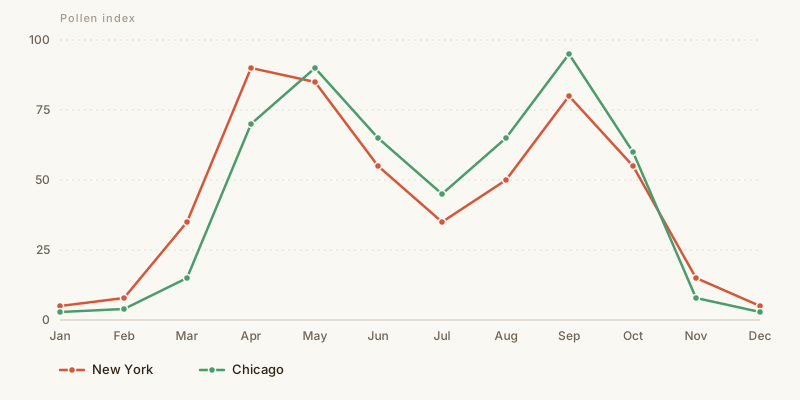
Chart informed by historical monthly counts published by the AAAAI National Allergy Bureau (pollen.aaaai.org/nab), regional NOAA climate normals (1991–2020), and AAFA Allergy Capitals rankings. Values are typical-year illustrative averages—daily counts vary substantially with weather and year-to-year plant phenology.
The shape is what matters here. Both lines trace the same humid-continental silhouette—quiet winter, sharp spring peak, summer dip, sharper fall peak—but Chicago's spring lags New York's by about two weeks, and the September ragweed peak is unambiguously taller for Chicago. Two cities, one climate, two calendars.
What This Means if You're Traveling, Moving, or Visiting
A few practical implications fall out of the comparison:
- NYC → Chicago in spring—time your trip carefully. Early April in Chicago is usually quieter than New York. Late April to mid-May, the relationship flips and Chicago is briefly more intense.
- NYC → Chicago in September—brace for a worse ragweed season than you're used to, even if you've handled New York's ragweed for years. The Midwest agricultural transport adds a layer.
- Chicago → NYC in May—depending on the exact week, you may walk into New York's tree-pollen taper rather than its peak. The two-week offset works in your favor for late spring travel.
- Chicago → NYC in September—usually noticeable relief from ragweed. Not a complete reset, but a real one.
- Either direction, in winter—both cities are quiet. Chicago is the marginally cleaner destination if you're highly sensitive to early-spring trace counts.
- Within Chicago specifically—pay attention to lake-breeze days. Lakefront neighborhoods can be much cleaner than inland on the same afternoon, and the daily forecast may not capture the gradient.
Where the Cities Are Surprisingly Similar
For all the differences in timing and ragweed load, the two cities have more in common than the differences suggest.
Both have lengthening pollen seasons. A 2021 study in Proceedings of the National Academy of Sciences (Anderegg et al.) found that pollen seasons in North America have lengthened by roughly 20 days over three decades, with airborne pollen concentrations up about 21 percent. Both New York and Chicago sit firmly inside that trend line. For more on how seasons have shifted and why, see our guide to understanding pollen seasons.
Both cities show heat-island effects extending tree pollen season at the urban core, a phenomenon that's particularly visible in Manhattan and the Loop. Trees in dense urban cores break dormancy earlier and pollinate longer than trees in surrounding suburbs.
Both cities are squarely in the top tier of U.S. metro areas for ragweed exposure—the AAFA Allergy Capitals ranking lists both metros every year. Even though Chicago typically scores higher on the ragweed-specific axis, "lower than Chicago" is not the same as "low." A New Yorker with severe ragweed allergy is still in a high-exposure environment.
And both cities show clear correlations between rainfall the prior winter and pollen intensity the following spring—wet winters drive heavier biomass, which drives heavier pollen. Both have urban tree canopy programs that have been steadily increasing the per-capita tree count over the past two decades, which means baseline tree pollen in both cities is trending up regardless of climate.
Check Today's Count
The seasonal picture earlier in this guide is the backdrop. What you need on any given morning is the daily forecast for your city. Pull up today's New York forecast or today's Chicago forecast—both are updated every morning with tree, grass, and weed breakdowns.
If you're trying to interpret the daily score in light of the seasonal pattern this article walked through, the pollen forecast guide explains what the index ranges mean for symptoms.
For a more dramatic comparison, our NY vs. LA pollen guide covers two cities running entirely different climate operating systems—useful if you're moving between coasts rather than within them.
Sources and Further Reading
- AAAAI National Allergy Bureau (NAB), monthly station data—
https://pollen.aaaai.org/nab - AAFA Allergy Capitals annual ranking—
https://aafa.org/allergies/allergy-capitals/ - Anderegg, W.R.L. et al. (2021). "Anthropogenic climate change is worsening North American pollen seasons." Proceedings of the National Academy of Sciences 118 (7).
- NOAA U.S. Climate Normals 1991–2020—
https://www.ncei.noaa.gov/products/land-based-station/us-climate-normals - USDA Plant Hardiness Zone Map—
https://planthardiness.ars.usda.gov