If you've spent your whole adult life managing seasonal allergies in New York and you've assumed Miami would be a clean break—warm winter, no ragweed, no oak storm in April—there's a surprise waiting for you. New York and Miami don't just have different climates. Their pollen calendars are inverted. The exact months New Yorkers consider their worst (April–May for trees, September for ragweed) are Miami's quietest stretch of the year. The months New Yorkers consider their safest (December through March) are Miami's peak. The article below walks through the inversion season by season, names the species that drive Miami's surprising winter pollen load, and explains why so many snowbird transplants discover a brand-new allergy profile after their first January in Florida.
Two Cities, Two Climate Operating Systems
New York sits at the boundary of humid subtropical (Köppen Cfa) and humid continental (Dfa). Hard winter freezes shut down photosynthesis, force trees into dormancy, and drop pollen counts to near zero from December through February. The seasons are sharp, the winter is real, and the pollen calendar is visibly bracketed by it.
Miami is tropical wet-and-dry (Köppen Aw, with monsoon influence in summer). There is no winter freeze. Subtropical and tropical species don't go dormant in the way Northeastern hardwoods do. They time their reproductive cycles around the dry season instead of around temperature, which means many of Miami's most allergenic species pollinate from December through March—exactly when New York is at its quietest. Then in summer, daily afternoon thunderstorms wash pollen out of the air for hours, suppressing counts during the months when New York's grass and ragweed are climbing.
The two cities are running entirely different climate operating systems, the same way New York and Los Angeles are. But where LA's pattern is "year-round at moderate amplitude" (covered in our NY vs. LA comparison), Miami's pattern is "high in winter, low in summer"—the opposite of the Northeastern norm. That inversion is what makes the comparison useful.
Winter (Miami's Peak): The Snowbird Trap
December through March is peak pollen season in Miami, and it's the part of the year that catches Northeastern visitors off guard. Several species are simultaneously at their seasonal high:
Live oak (Quercus virginiana) is the dominant winter tree allergen in South Florida. It's a different species from the Northern red oak that drives New York's April spring storm—different timing, different protein profile, often experienced as a different allergy by people who react to both. Live oak pollinates January through March, with February typically the peak month.
Australian pine (Casuarina equisetifolia) is technically not a pine at all—it's a flowering tree that looks pine-like and was widely planted across South Florida from the 1890s through the mid-20th century. It's now classified as a Class I invasive species, but mature stands persist along beaches, canals, and roadsides throughout the Miami metro area. It produces enormous quantities of windborne pollen across a long winter season, and is one of the most aggressive aeroallergens in the region.
Brazilian pepper (Schinus terebinthifolia), another invasive, pollinates fall through early winter. It's in the same plant family as poison ivy, which means people with poison ivy contact allergies often cross-react to its pollen—an unwelcome surprise for anyone who's spent decades thinking they had no plant allergies in winter.
Bald cypress, juniper, wax myrtle, and various tropical hardwoods round out the winter pollen mix. The result is a pollen environment that looks nothing like New York's quiet December–February floor.
For more on how oak pollen drives allergic reactions and which species cross-react, see our tree pollen allergies guide. The mechanisms are the same—the species mix is what differs.
Spring (NYC's Peak, Miami's Transition)
April and May are New York's worst weeks. Tree pollen builds from mid-March through early May, with oak, maple, birch, ash, sycamore, and hickory pollinating simultaneously by late April. We've covered the New York spring tree barbell in detail in our NY vs. LA and NYC vs. Chicago comparisons—same calendar, same species.
Miami in spring is doing something different. Live oak is tapering off through April. Australian pine remains a steady presence but starts declining as the wet season approaches. Bahia and Bermuda grasses are beginning to assert themselves, but they don't reach summer levels until rain patterns shift. The Florida air is warming, humidity is climbing, and the dry-season pollen drivers are losing momentum.
The result: Miami in April and May has moderate pollen counts that are consistently lower than the dry-season high but still above the wet-season trough. It's the cleanest stretch of the year for many sufferers, and it happens precisely when New York is at its sneeziest. A New Yorker visiting Miami in early May for relief from oak season usually gets exactly what they came for.
Summer (The Great Suppression)
The structural twist that makes Miami's pollen year unique is its summer. From June through October, Miami enters a wet season that lives up to the name. Daily afternoon thunderstorms are the climatic norm rather than the exception. Storms physically wash pollen out of the air, and the high humidity and frequent rain prevent regrowth from accumulating airborne loads the way drier climates do.
Bahia grass (Paspalum notatum) and Bermuda grass (Cynodon dactylon) dominate the local turf inventory year-round. In any other warm-climate city, that would mean a heavy summer grass season. In Miami, the daily rain washout keeps counts substantially below what a Bahia-grass-dominated landscape would otherwise produce. Pollen counts in July and August are routinely Miami's lowest of the year.
Hurricane season (June through November, peaking August through October) extends the suppression. A major storm physically clears the air for days, often longer if power outages and structural disruption delay landscaping and grounds maintenance. There's a small offsetting effect 4–6 weeks after each hurricane: ground disturbance and vegetative regrowth can produce a brief weed-pollen bloom, particularly from pioneer species filling disturbed soil. But the dominant signal during hurricane season is suppression, not amplification.
While Miami counts are dropping, New York's grass season is climbing through May, June, and July, then tapering as ragweed builds in August. For most of the summer, the two cities' pollen profiles are pointing in opposite directions: New York rising, Miami falling.
Fall (NYC's Second Peak, Miami's Quiet)
September is New York's second worst month. Common ragweed (Ambrosia artemisiifolia) and giant ragweed (A. trifida) drive a sharp peak that lasts until the first hard frost in late October or early November. We've covered the New York ragweed season in the comparisons linked above; the species and the timing are the same.
Miami has minimal ragweed. The species exists in Florida but isn't well-adapted to the local hydrology—the wet-season rains and the absence of large agricultural ragweed source regions limit the load. Some local fall weeds (sea grape, sea oxeye, early wax myrtle) contribute, but the cumulative intensity is far below New York's. Through September and October, Miami counts are in the moderate range and starting to rise toward the winter peak—but still well below the dry-season high that begins in November.
A ragweed-allergic New Yorker spending September in Miami often experiences dramatic relief. The trigger species essentially isn't there. The same pattern holds in Los Angeles, covered in our NY vs. LA pollen comparison—both cities sit outside the dominant North American ragweed corridor, just for different climatic reasons.
The Full Year in One Chart
The inversion is easier to see than to describe. Here's the typical year for both cities, plotted as a monthly pollen index:
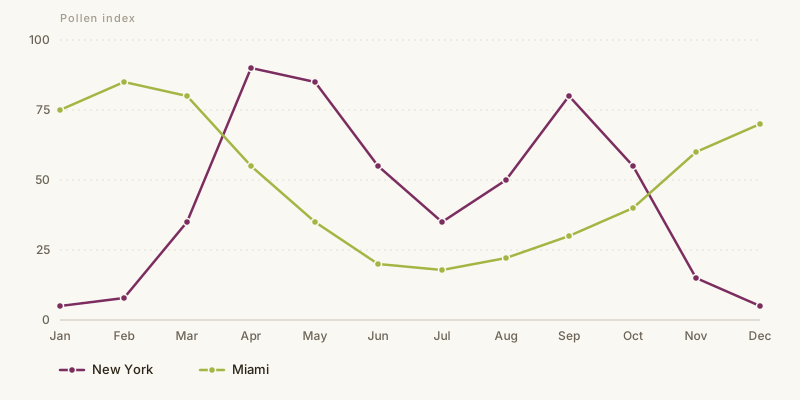
Chart informed by historical monthly counts published by the AAAAI National Allergy Bureau (pollen.aaaai.org/nab), regional NOAA climate normals (1991–2020), and Florida tropical-pollen literature. Values are typical-year illustrative averages—daily counts vary substantially with weather, hurricane activity, and year-to-year plant phenology.
The shape is what matters. New York's familiar barbell—two mountains, a summer valley between them, a quiet winter floor—sits in mirror image to Miami's profile. The two lines visibly cross in late spring and again in late fall, and the crossover months (May, October) are roughly the only stretches when both cities are at moderate counts simultaneously.
What This Means for Snowbirds, Transplants, and Travelers
A few practical implications fall out of the inversion:
- NYC → Miami in December–March—the move that catches people off guard. Northeasterners arriving for "winter relief" walk into peak live oak, Australian pine, and Brazilian pepper season. People who have never had allergies in winter often discover they react to subtropical species. If you're sensitive, talk to your doctor about starting allergy medication 1–2 weeks before your trip, just as you would for tree season back home.
- NYC → Miami in summer—the relief is real, especially for ragweed sufferers in September. Wet-season suppression keeps counts low.
- Miami → NYC in winter—real relief from live oak, Australian pine, and Brazilian pepper. New York's December and January are about as quiet as pollen seasons get.
- Miami → NYC in spring—anyone sensitive to oak, maple, or birch will likely have a worse-than-usual spring, especially if they've adapted to live oak's earlier timing back home.
- Miami → NYC in fall—ragweed exposure may produce symptoms that Miami never triggered. New York's September is one of the higher exposure environments in the country.
- Year-round residents in either city—a daily forecast is more useful than a seasonal calendar. In Miami, post-storm days are often the cleanest. In New York, the early-spring and early-fall windows are the planning priority.
Where the Cities Are Surprisingly Similar
For all the inversion, the two cities have more structural similarities than the climate gap would suggest.
Both have lengthening pollen seasons. A 2021 study in Proceedings of the National Academy of Sciences (Anderegg et al.) found that pollen seasons in North America have lengthened by roughly 20 days over three decades, with airborne pollen concentrations up about 21 percent. The trend is visible in both National Allergy Bureau station data for New York and in Miami-area sampling. For the deeper background, see our guide to understanding pollen seasons.
Both cities show heat-island effects extending tree pollen season at the urban core. Trees in dense Manhattan blocks break dormancy earlier than trees in the surrounding suburbs. The same pattern shows up in Miami—coastal urban tree canopies pollinate earlier and longer than rural and exurban areas—though the magnitude is different because Miami's seasonal rhythm is different to begin with.
Both have ocean-side modulation effects. New York's Atlantic exposure moderates winter temperatures and creates onshore-vs.-offshore wind variation that affects daily counts. Miami's Atlantic and Biscayne Bay exposure produces a similar daily sea-breeze pattern, often pushing local pollen inland through the afternoon. Neither effect is as structured as Lake Michigan's lake-breeze front in Chicago (covered in our NYC vs. Chicago pollen comparison), but both contribute to neighborhood-level variation.
And both cities have invasive-species pressure that is changing what allergens dominate over time. New York's Norway maple (Acer platanoides) has spread aggressively in urban green spaces over the past century. Miami's Australian pine, Brazilian pepper, and melaleuca have reshaped the local pollen profile in ways the historical record from earlier in the 20th century wouldn't recognize.
Check Today's Count
The seasonal picture earlier in this guide is the backdrop. What you need on any given morning is the daily forecast for your city. Pull up today's New York forecast or today's Miami forecast—both are updated every morning with tree, grass, and weed breakdowns.
If you're trying to interpret the daily score in light of the seasonal pattern this article walked through, the pollen forecast guide explains what the index ranges mean for symptoms.
For more comparisons in the series, our NY vs. LA pollen guide covers the year-round-at-moderate-amplitude pattern, and our NYC vs. Chicago pollen guide covers two Northeastern cities running the same climate operating system with different tuning.
Sources and Further Reading
- AAAAI National Allergy Bureau (NAB), monthly station data—
https://pollen.aaaai.org/nab - AAFA Allergy Capitals annual ranking—
https://aafa.org/allergies/allergy-capitals/ - Anderegg, W.R.L. et al. (2021). "Anthropogenic climate change is worsening North American pollen seasons." Proceedings of the National Academy of Sciences 118 (7).
- NOAA U.S. Climate Normals 1991–2020—
https://www.ncei.noaa.gov/products/land-based-station/us-climate-normals - USDA Plant Hardiness Zone Map—
https://planthardiness.ars.usda.gov - Florida Department of Agriculture & Consumer Services invasive species list—
https://www.fdacs.gov