Los Angeles and Phoenix sit on the same warm-winter half of the country, share a long list of imported ornamental species, and lean on the same heat-tolerant Bermuda grass for their lawns. From a distance they look like the same allergy environment with two different zip codes. They aren't. The Pacific moderates LA into a year-round Mediterranean plateau where pollen is always present at modest levels and rarely spikes. The Sonoran Desert pushes Phoenix into the opposite shape: two tall peaks separated by quiet stretches, with a notorious spring tree-pollen surge in February through April and a second peak in late summer driven by something LA has no equivalent for—the North American monsoon. The article below walks through the comparison season by season, names the species and regulatory history driving each profile, and explains why a flight from LAX to PHX in March or August can feel like landing in a completely different allergy environment.
Two Warm-Winter Cities, Two Precipitation Regimes
Both cities skip the hard winter freeze that defines Northeastern allergy seasons. Neither has a true dormancy floor. But their precipitation regimes are inverted, and that single climatic difference does most of the work in shaping their pollen calendars.
Los Angeles is Mediterranean (Köppen Csa transitioning to Csb along the coast). The Pacific provides marine layer cooling, winter brings the year's only meaningful rainfall, and summers are reliably dry. The result is a smooth growing season that runs from late winter through spring, slows through the dry summer, and picks back up modestly through fall as cypress, juniper, and acacia start their winter cycle. Pollen is always around. It rarely surges.
Phoenix is hot desert (Köppen BWh, Sonoran subtype). Winter precipitation is sparse but reliable enough to cue a heavy spring growth pulse. Summer is dominated by the North American monsoon: from roughly June 15 through September 30, daily afternoon thunderstorms and tropical moisture surges deliver most of the year's rainfall in a concentrated window. Plants respond. The monsoon triggers a second growing season, and a second pollen peak, that turns Phoenix's late summer into the second-worst stretch of the year for sufferers.
The macro shape that follows is straightforward: LA produces a flat plateau, Phoenix produces twin peaks, and the two profiles only briefly overlap in the late-fall and early-winter shoulder months.
Spring Trees: Shared Species, Different Intensity
Both cities draw on a similar list of imported ornamentals for their spring tree pollen. Olive (Olea europaea), juniper (Juniperus), ash (Fraxinus), and mulberry (Morus) appear in both canopies. Mediterranean cypress (Cupressus sempervirens) and pepper tree (Schinus molle) are common in LA. Both cities planted these species widely from the early 20th century onward because they tolerate heat, light irrigation, and poor soils.
What separates the two springs is what Phoenix adds on top. The Sonoran Desert canopy includes mesquite (Prosopis velutina, P. glandulosa) and palo verde (Parkinsonia)—native legumes with abundant windborne pollen, both well-adapted to the desert and both dominant across the Phoenix metro area's natural and ornamental landscapes. Mesquite and palo verde stack on top of the imported species rather than replacing them, and the cumulative spring tree load in Phoenix is meaningfully higher than what LA produces.
The timing also runs slightly earlier in Phoenix. Mesquite and juniper start ramping in February, with a peak that arrives in March and April rather than the late-March-to-April peak more typical of LA's olive and oak. By the time LA's spring is hitting its modest high, Phoenix sufferers are deep into the worst stretch of their year. Verdict: Phoenix is meaningfully harder than LA for spring tree-pollen sufferers, both in absolute count and in duration.
The Mulberry and Olive Story
One of the most direct examples of allergen-driven urban planning in the United States happened in Maricopa County in the mid-1980s. After two decades of resident complaints and aggressive expansion of mulberry and olive plantings across new Phoenix subdivisions, the county passed a pollen ordinance prohibiting the planting of new fruitless mulberry and olive trees within urban areas. Pima County (Tucson) followed with similar olive restrictions. The bans don't retroactively remove existing trees, so the legacy load remains in older neighborhoods, but the rules effectively froze the further expansion of two of the region's most aggressive aeroallergens.
Los Angeles never enacted comparable countywide restrictions. Olive remains widely planted across LA County and contributes a meaningful share of the spring count. Some California municipalities have voluntarily moved away from male-clone olives in new ornamental work, but there is no equivalent regional ordinance.
The result is a small irony: Phoenix's notorious allergy reputation in the 1970s and early 1980s drove a regulatory response that has slowly improved the long-term trajectory of its mulberry and olive load. LA's milder reputation never produced the same political pressure, so its olive contribution has remained roughly steady.
Summer Grass: Low and Lower
Both cities are dominated by Bermuda grass (Cynodon dactylon), the heat-tolerant warm-season turfgrass that out-competes cool-season grasses across the southern United States. Summer grass pollen in both cities is real but lower-amplitude than what cool-season grass cities like New York or Chicago produce.
LA's grass season is steady-state. Year-round irrigation and the milder summer heat keep residential and commercial lawns producing pollen from May through September. Counts are moderate, not high.
Phoenix's grass season is shorter and quieter than LA's. Two factors compress it. First, residential turfgrass coverage has declined materially over the past two decades as drought-tolerant xeriscaping has displaced lawns across new development and many retrofits. Second, the brutal summer heat stresses what remains. The result is a modest grass-pollen contribution that drops out almost entirely during the early-summer trough between Phoenix's spring and monsoon peaks.
Verdict: broadly similar across both cities, with Phoenix slightly lower on grass alone. Neither city behaves like the cool-season-grass-dominated cities of the Northeast and Midwest, both of which we covered in our NYC vs. Chicago pollen comparison.
The Monsoon Pulse: Phoenix's Second Peak
The feature that most clearly differentiates the two cities is what happens in Phoenix in late summer. The North American monsoon arrives in the Sonoran Desert on roughly June 15 each year and lasts until September 30 (the official window used by the National Weather Service). It's a recurring pattern of afternoon thunderstorms driven by tropical moisture from the Gulf of California and the Eastern Pacific, often preceded by dust outflow boundaries (haboobs) that sweep across the metro.
Plants respond. Annual weeds and grasses that have been dormant through the dry early summer green up rapidly and begin producing pollen within weeks. Common ragweed (Ambrosia species) is present in the desert despite Phoenix's reputation as a low-ragweed city, and it benefits directly from monsoon moisture. Russian thistle (Salsola tragus), careless weed (Amaranthus palmeri), burroweed (Isocoma tenuisecta), and several native bursages contribute heavily. By August and September the Phoenix pollen count is back near its spring high, driven now almost entirely by weeds rather than trees.
LA has no monsoon. Its summers are dry, its weeds are stressed, and its fall is gentle. While Phoenix is climbing through its second peak of the year, LA is in its quietest stretch—pollen counts in late summer are usually the year's lowest in coastal California.
Verdict: Phoenix's late summer is the second-worst stretch of its year. LA's late summer is one of its calmest. The monsoon pulse is the most important single structural difference between the two cities' pollen calendars.
Fall and Winter: Where Los Angeles Edges Back In
By mid-October the Phoenix monsoon has wound down, the desert returns to its dry-cool baseline, and pollen counts drop. November and December are the year's quietest stretch in Phoenix—dry, mild, and largely free of the spring legume bloom and the monsoon weed surge alike.
LA in late fall is doing the opposite. Mediterranean cypress, juniper, acacia, and the late-season weeds (mugwort, Russian thistle along disturbed margins) start their winter pollination cycle as the marine layer thickens and the first storms of the wet season arrive. Counts climb modestly from October through February, with a small peak in February and March that aligns with the first burst of oak and olive activity.
The result is the only stretch of the year when LA is, on average, slightly higher than Phoenix: roughly mid-October through mid-February. Verdict: LA wins this round only in the sense that "wins" means "still has measurable pollen." Neither city is hard on sufferers in winter.
Dust as a Multiplier
A note for travelers and new arrivals to Phoenix that has nothing to do with pollen directly. Phoenix routinely exceeds federal PM10 standards because of Sonoran dust. Haboob events—dust outflow boundaries kicked up ahead of monsoon thunderstorms—periodically push particulate levels well above safe thresholds for hours or days, and the chronic baseline of windblown dust is higher than what LA's coastal exposure produces.
For people with allergic asthma, dust amplifies the symptom load pollen alone would produce. A moderate pollen day in Phoenix during a dust event can feel substantially worse than the same count on a clean day. LA has its own air-quality story (ozone, periodic wildfire smoke), but the dust-pollen interaction is specifically a Phoenix phenomenon worth flagging. Maricopa County publishes dust forecasts alongside PM10 monitoring; managing allergic respiratory disease in Phoenix benefits from watching both signals together.
The Full Year in One Chart
The structural difference is easier to see than to describe. Here is the typical year for both cities, plotted as a monthly pollen index:
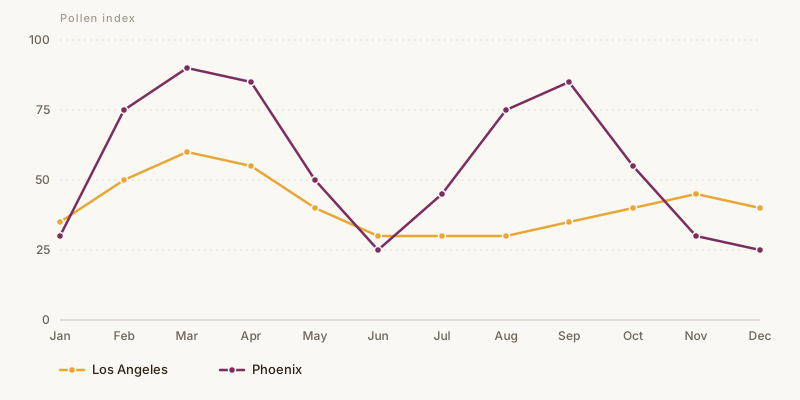
Chart informed by historical monthly counts published by the AAAAI National Allergy Bureau (pollen.aaaai.org/nab), regional NOAA climate normals (1991–2020), and Maricopa County Air Quality Department reports. Values are typical-year illustrative averages—daily counts vary substantially with weather, monsoon timing, and year-to-year plant phenology.
The shape is what matters. LA's plateau sits in a narrow band from roughly 30 to 60 across the year. Phoenix climbs from a quiet January floor to a spring peak around 90 in March and April, drops sharply through May and June, and climbs again to a second peak in August and September. The two curves cross in May, October, and November, and the only stretches where LA sits higher than Phoenix are the late-fall and early-winter shoulder months.
What This Means for Travelers, Transplants, and Movers
A few practical implications fall out of the comparison:
- LA → Phoenix in March or April: a much harder allergy month than expected. The combined mesquite, palo verde, juniper, mulberry, and olive load is heavier than anything LA produces.
- LA → Phoenix in early July: misleading. The desert is in its early-summer trough and counts are at or below LA levels. Wait until mid-July, when the monsoon arrives, and the picture flips.
- LA → Phoenix in August or September: the second hard stretch. Monsoon-fed weeds and ragweed produce a peak comparable to the spring tree surge.
- Phoenix → LA in winter: marginal worsening, mostly cypress, juniper, and acacia plus the start of LA's olive and oak cycle.
- Phoenix → LA in fall: real relief. LA's late summer and early fall are among the cleanest weeks anywhere in the country.
- Year-round residents in either city: a daily forecast matters more than a seasonal calendar. In Phoenix, watch pollen and dust together during monsoon season. In LA, the daily forecast helps separate the modest peaks from the quieter plateau weeks. The pollen forecast guide explains the daily index in both cases.
Where the Cities Are Surprisingly Similar
For all the structural differences, the two cities have a long list of shared characteristics that reflect their common Sun Belt heritage.
Both have measurably lengthening pollen seasons. A 2021 study in Proceedings of the National Academy of Sciences (Anderegg et al.) found that pollen seasons in North America have lengthened by roughly 20 days over three decades, with airborne pollen concentrations up about 21 percent. Both LA and Phoenix sit in regions where the climate-driven extension is among the more pronounced in the country. For the deeper background, see our guide to understanding pollen seasons.
Both inherited a non-native ornamental load from a century of urban planting choices. Olive, mulberry, eucalyptus, and Bermuda grass were all imported across the Southwest from elsewhere—the Mediterranean basin, Australia, sub-Saharan Africa—and would not be the dominant residential canopy in either city under purely native succession. Both cities are slowly, unevenly, working back toward more native-adapted plantings.
Both have heat-island effects extending tree pollen season at the urban core. Phoenix's heat island is one of the most intense in the country and produces measurable phenological shifts in urban-versus-exurban tree timing. LA's coastal moderation softens the effect but does not eliminate it.
And both cities are climate-vulnerable in ways that point to longer, possibly more intense pollen seasons over the next two decades—LA from longer dry seasons and wildfire-driven plant turnover, Phoenix from monsoon variability and rising mean temperatures.
Check Today's Count
The seasonal picture in this guide is the backdrop. What you need on any given morning is the daily forecast for your city. Pull up today's Los Angeles forecast or today's Phoenix forecast—both update every morning with tree, grass, and weed breakdowns.
For more comparisons in the series, our NY vs. LA pollen guide covers the year-round-Mediterranean-plateau pattern from LA's perspective against the Northeastern barbell, and our NYC vs. Miami pollen guide covers another warm-winter comparison where the calendars run in opposite directions for very different climatic reasons.
Sources and Further Reading
- AAAAI National Allergy Bureau (NAB), monthly station data—
https://pollen.aaaai.org/nab - AAFA Allergy Capitals annual ranking—
https://aafa.org/allergies/allergy-capitals/ - Anderegg, W.R.L. et al. (2021). "Anthropogenic climate change is worsening North American pollen seasons." Proceedings of the National Academy of Sciences 118 (7).
- NOAA U.S. Climate Normals 1991–2020—
https://www.ncei.noaa.gov/products/land-based-station/us-climate-normals - USDA Plant Hardiness Zone Map—
https://planthardiness.ars.usda.gov - Maricopa County Air Quality Department, dust forecasts and PM10 monitoring—
https://www.maricopa.gov/Air-Quality - National Weather Service, Phoenix, "Southwest Monsoon"—
https://www.weather.gov/psr/Monsoon