If you assume "California" implies a single allergy climate, this comparison will surprise you. Within 350 miles, the same Mediterranean climate produces two completely different pollen years. Los Angeles runs an elevated, year-round profile with a broad spring peak and no clean off-season. San Francisco runs almost the opposite: one sharp late-winter peak driven largely by Monterey cypress and acacia, then ten months of fog-suppressed counts that put it among the lowest-burden major U.S. metros year after year. The article below walks through the contrast season by season, names the species and the climatic mechanism that drives each, and explains why someone moving from one Bay Area neighborhood to a Westside LA one often discovers a new pollen calendar entirely.
Same Climate Family, Different Operating Systems
Both cities are Mediterranean (Köppen Csa for Los Angeles, Csb for San Francisco), and the family matters: neither has a hard winter freeze. The dormancy reset that governs Northeast pollen calendars—covered in our NY vs. LA pollen comparison—doesn't happen in either place. Both cities have a measurable winter pollen baseline.
The variant matters too. SF's "warm-summer Mediterranean" (Csb) is actually a cool summer Mediterranean. Daily highs in San Francisco average in the low- to mid-60s°F through July and August, driven by Pacific upwelling and the marine layer that rolls in from late afternoon through mid-morning, June through September. LA's hot-summer Mediterranean (Csa) runs 25–30°F warmer inland in the same months, with the San Fernando Valley regularly above 90°F when the Westside is in the high 70s. That single temperature gap—a wedge of cool, wet, marine air sitting on the Bay all summer—drives almost everything that follows.
Winter (SF's One Peak, LA's Quiet Hum)
Late January through March is peak San Francisco pollen season, and it's the only stretch of the year SF residents reliably brace for. Several species are simultaneously at their seasonal high.
Monterey cypress (Cupressus macrocarpa) is the city's dominant late-winter tree allergen. It lines the Presidio plantings, ridgelines, and parks across the Bay Area, and it pollinates heavily in February. The pollen is small, abundant, and produces strong reactions in cypress-sensitive sufferers—often experienced as a brand-new allergy by transplants who never lived near significant cypress plantings before. Acacia (especially Acacia dealbata, silver wattle) pollinates in the same window and is widespread across the Bay Area's hills and parks. Italian cypress and juniper round out the mix.
LA in the same months has its own moderate winter activity: olive (Olea europaea), pepper tree (Schinus molle), juniper, ash, and acacia. But LA's winter is part of a continuous year-round elevated baseline rather than a sharp peak. There is no single month LA spikes the way SF does in February, and there is no single month LA goes quiet the way SF does in July. The shapes are different.
For more on how cypress and other tree pollens drive symptoms and which species cross-react, see our tree pollen allergies guide. The mechanisms are the same in both cities—it's the species mix and the timing that differ.
Spring (LA's Broad Peak, SF Tapering)
LA's peak season runs from late February through May. The dominant species are coast live oak (Quercus agrifolia), valley oak (Q. lobata), California sycamore (Platanus racemosa), mulberry (Morus), olive continuing into May, walnut (Juglans), and pepper tree. Several of these pollinate simultaneously through April, which is why allergy clinics across the Los Angeles basin see their highest patient volume in that window. The shape is broad—a long shoulder rather than a single mountain—because no hard freeze synchronizes the species the way it does in the Northeast.
San Francisco in spring is the tail end of its cypress-acacia peak, plus modest oak, birch, and ash contribution. Counts drop steadily from March through May as the marine layer begins to assert itself and the cypress shedding finishes. By late April, SF is on its way down precisely when LA is still climbing. The two cities' pollen profiles diverge most visibly in this window: LA's elevated, broad spring against SF's quieter, declining one.
Summer (The Marine-Layer Collapse)
This is the article's structural centerpiece. From June through September, San Francisco pollen counts collapse to among the lowest of any major U.S. metro—routinely below the levels seen even in dry desert cities—because of a single atmospheric mechanic that no other major American city has at the same scale.
The marine layer is a wedge of cool, moist Pacific air pulled inland by upwelling along the California coast. Through summer, it typically rolls in from late afternoon through mid-morning, often shrouding the city in fog through the entire day. Cool air at high humidity reaches dewpoint repeatedly, condensing droplets that physically bind airborne particles—including pollen—and pull them out of suspension. Day after day, week after week, that combination keeps SF's airborne pollen load substantially below what its plant inventory alone would produce.
The plant inventory is also working against pollen production. Bermuda grass (Cynodon dactylon), the dominant warm-season grass that drives LA's summer counts, struggles to establish in SF's cool soils. Cool-season grasses (Kentucky bluegrass, perennial ryegrass, fescue) dominate Bay Area lawns instead, and they peak earlier and lower than Bermuda. The combined effect: SF's July and August are typically its lowest-pollen months of the year.
LA in the same months maintains moderate counts. Bermuda grass takes over from cool-season grasses, pepper trees continue, and irrigation keeps lawns producing across the basin. The gap between the two cities is widest in July and August, and it shows up in symptoms: a Bermuda-grass-allergic Angeleno spending July in San Francisco often experiences dramatic relief, of a kind comparable to the wet-season suppression Northeasterners discover when they spend July in Miami (covered in our NYC vs. Miami pollen comparison).
Fall (Both Quiet, Both for the Same Reason)
Neither city has meaningful ragweed. Common ragweed (Ambrosia artemisiifolia) is a continental-interior species that needs summer rainfall to establish, and Mediterranean coastal climates don't provide it. The same finding holds for both LA and SF: a ragweed-allergic visitor from New York or Chicago will typically feel substantial relief in either California city during September.
Some local fall weeds contribute. Inland LA basins see mugwort (Artemisia), Russian thistle (Salsola tragus, the airborne tumbleweed), and pigweed (Amaranthus), often pushed into the basin by Santa Ana wind events. SF has lower aggregate weed exposure in fall and a generally quiet October and early November, with brief upticks from late grasses and weeds. By any measure that matters to a fall-ragweed sufferer, both California cities are friendlier than virtually any major Northeastern or Midwestern metro—the Chicago vs. NYC comparison covers what the same season looks like at the other end of the spectrum.
For background on how ragweed timing and exposure work in cities that do have it, see our understanding pollen seasons guide.
The Full Year in One Chart
The contrast is easier to see than to describe. Here's the typical year for both cities, plotted as a monthly pollen index:
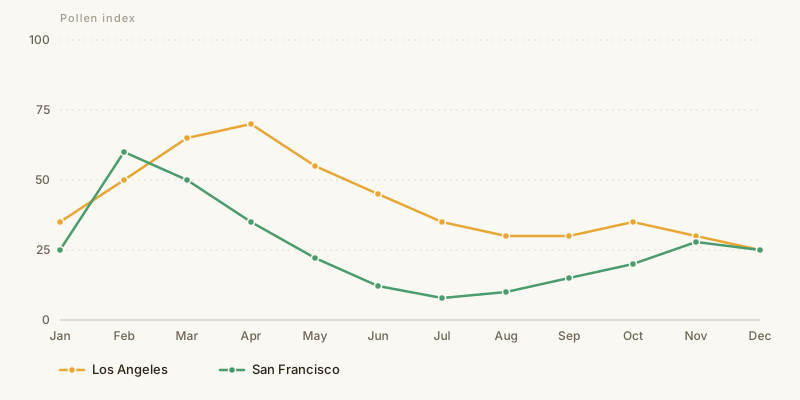
Chart informed by historical monthly counts published by the AAAAI National Allergy Bureau (pollen.aaaai.org/nab), regional NOAA climate normals (1991–2020), and AAFA Allergy Capitals rankings. Values are typical-year illustrative averages—daily counts vary substantially with marine-layer behavior, Santa Ana wind events, and year-to-year plant phenology.
The shape is what matters. LA traces a long, broad-shouldered curve that never drops below moderate levels—the same year-round-at-moderate-amplitude pattern visible in our NY vs. LA pollen comparison, redrawn here for series continuity. San Francisco traces something closer to a single February mountain followed by a deep summer trough. The two lines visibly cross in early February, separate dramatically through summer, and reconverge in late fall.
What This Means for Movers, Travelers, and Visitors
A few practical implications fall out of the seasonal comparison:
- LA → SF in summer—real relief, especially for grass-allergic sufferers. The marine layer is doing the work of an air filter at neighborhood scale.
- LA → SF in February—a brand-new and unexpected peak. Anyone sensitive to cypress or acacia who has never lived in the Bay Area may experience symptoms they associate only with springtime back home.
- SF → LA year-round—more exposure than San Franciscans are used to, with no single relief season. Daily forecasts matter more than seasonal calendars.
- Bay Area outdoor event planning—avoid late February through mid-March if anyone in the wedding party reacts to cypress or acacia. The rest of the year, even peak grass season, is mild by national standards.
- LA outdoor event planning—no single window is reliably clean. Spring is the worst, summer is moderate, fall and early winter are the cleanest stretches but never quiet. The daily forecast is the only reliable planning input.
- Year-round residents in either city—the daily count is more useful than a seasonal calendar in LA. In SF, the seasonal calendar is enough for most planning, with daily checks in February-March.
Where the Cities Are Surprisingly Similar
For all the contrast, the two cities have more structural similarities than the LA-vs.-SF gap might suggest.
Both lack the hard-freeze dormancy that resets Northeast pollen calendars, so both have year-round pollen baselines—just at very different levels. Both have measurably lengthening pollen seasons. A 2021 study in Proceedings of the National Academy of Sciences (Anderegg et al.) found that pollen seasons in North America have lengthened by roughly 20 days over three decades, with airborne pollen concentrations up about 21 percent. Both California cities are in the trend line.
Both have meaningful invasive-species pressure shaping the local pollen profile. SF's Tasmanian blue gum (Eucalyptus globulus), Australian acacia, and Monterey cypress (native to a tiny stretch of the Central Coast but planted everywhere) have reshaped the Bay Area canopy from what it was a century ago. LA's pepper tree, olive, and Australian eucalyptus have done the same to the basin. The historical record from earlier in the 20th century would not recognize either city's modern allergen mix.
Both have urban-microclimate effects that extend peaks at the city core. Trees in dense neighborhoods break dormancy earlier and pollinate longer than trees in surrounding suburbs and exurbs. The magnitude differs—SF's heat-island effect is muted by the marine layer—but the direction is the same.
And both cities have pronounced sub-regional variation that citywide forecasts hide. Coastal Santa Monica is dramatically lower than the inland San Fernando Valley in nearly every season. The Outer Sunset is foggier and lower than the Mission. Citywide averages can feel accurate to one resident and wrong to another a few miles inland.
Check Today's Count
The seasonal picture above is the backdrop. What matters on any given morning is the daily forecast for your city. Pull up today's Los Angeles forecast or today's San Francisco forecast—both are updated every morning with tree, grass, and weed breakdowns.
If you're trying to interpret the daily score in light of the seasonal pattern this article walked through, the pollen forecast guide explains what the index ranges mean for symptoms.
For more comparisons in the series, our NY vs. LA pollen guide covers the year-round-at-moderate-amplitude profile that LA shares with no other major U.S. city, our NYC vs. Chicago pollen guide covers two Northeastern cities running the same operating system with different tuning, and our NYC vs. Miami pollen guide covers a different suppression mechanic—wet-season thunderstorms washing pollen out of the air—that produces a similar summer collapse on the opposite coast.
Sources and Further Reading
- AAAAI National Allergy Bureau (NAB), monthly station data—
https://pollen.aaaai.org/nab - AAFA Allergy Capitals annual ranking—
https://aafa.org/allergies/allergy-capitals/ - Anderegg, W.R.L. et al. (2021). "Anthropogenic climate change is worsening North American pollen seasons." Proceedings of the National Academy of Sciences 118 (7).
- NOAA U.S. Climate Normals 1991–2020—
https://www.ncei.noaa.gov/products/land-based-station/us-climate-normals - USDA Plant Hardiness Zone Map—
https://planthardiness.ars.usda.gov - California Native Plant Society—
https://www.cnps.org